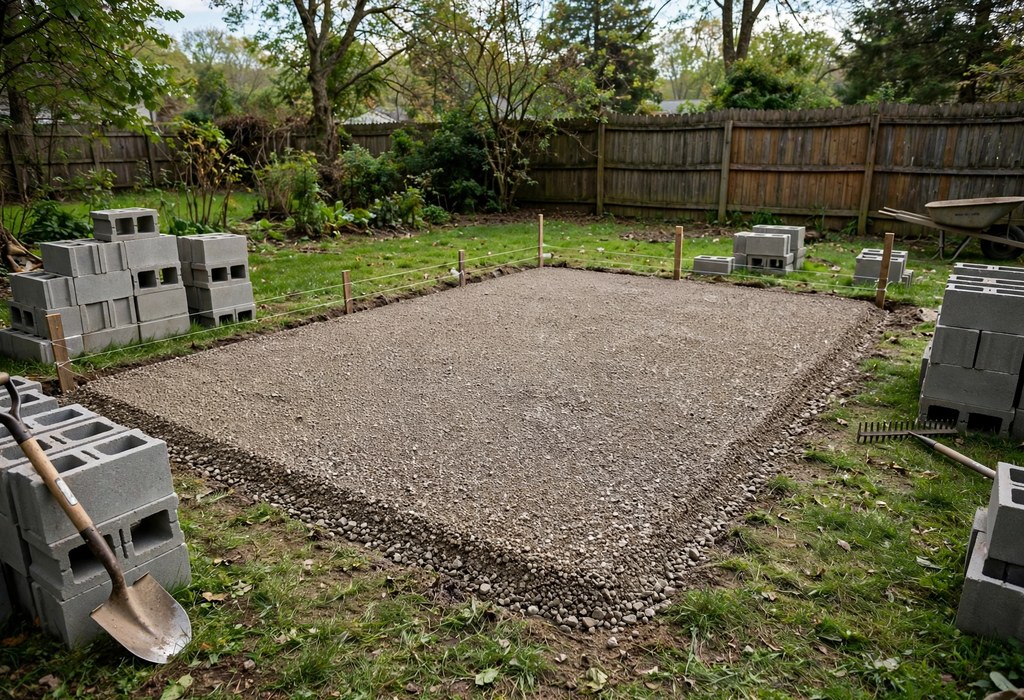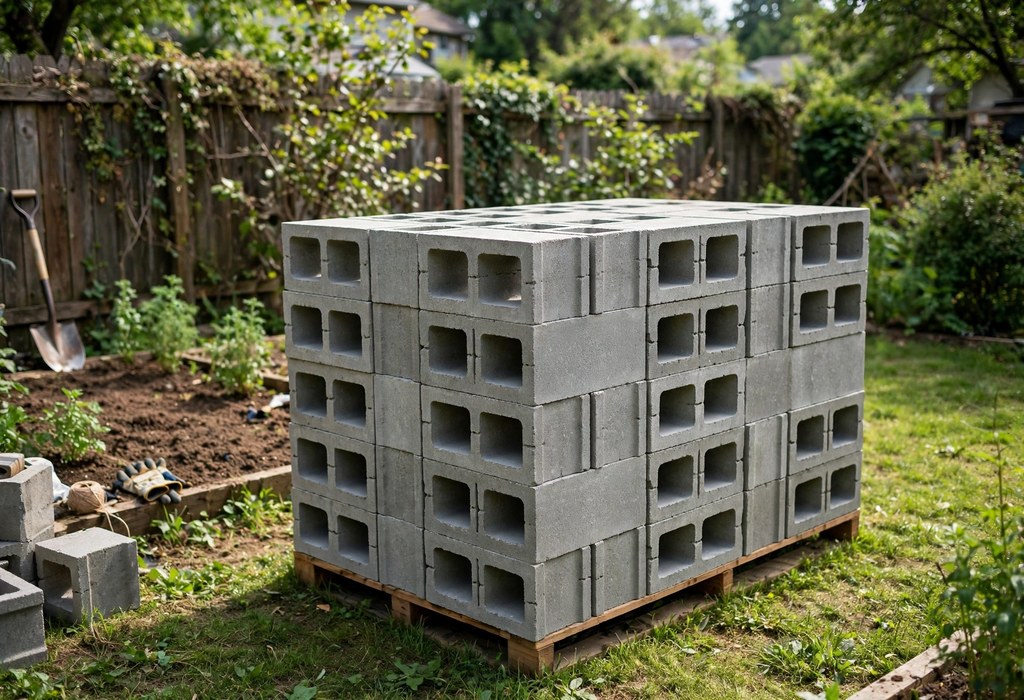
You need 16 cinder blocks to build one full course of a 4×8 raised bed. Most gardeners stack two courses, so the standard project uses 32 blocks total. As a result, add four extra blocks for waste, breakage, and future small repairs.
Standard concrete blocks measure 16 inches long, so that length drives the entire calculation. Therefore, each 8-foot side needs exactly six blocks, while each 4-foot end needs two. Meanwhile, corner overlap explains why the short ends hold fewer blocks than the simple math suggests. Finally, this guide provides a reusable formula that works for any bed size you plan.
Standard Cinder Block Dimensions
A concrete masonry unit, often called a CMU, measures 16 by 8 by 8 inches nominally. Real blocks run slightly smaller, about 15 5/8 inches long, to leave room for mortar joints. However, dry-stack gardeners ignore the mortar allowance and plan with the full 16 inches. Because of this standard, every 16 inches of wall length equals exactly one block.
The 16-inch length matters more than height or width for your count. Walls grow in 16-inch steps, so standard 4-foot and 8-foot sides divide evenly. Additionally, the 8-inch width becomes the thickness of your garden bed wall. Two stacked courses therefore create a 16-inch-tall wall for deep vegetable roots.
How Block Length Drives the Count per Side
Divide the length of each side by 16 inches to find its block count. An 8-foot side measures 96 inches, which gives you exactly six blocks. Similarly, a 4-foot side measures 48 inches, which suggests three blocks. Corners share some of that space, as the next section explains in detail.
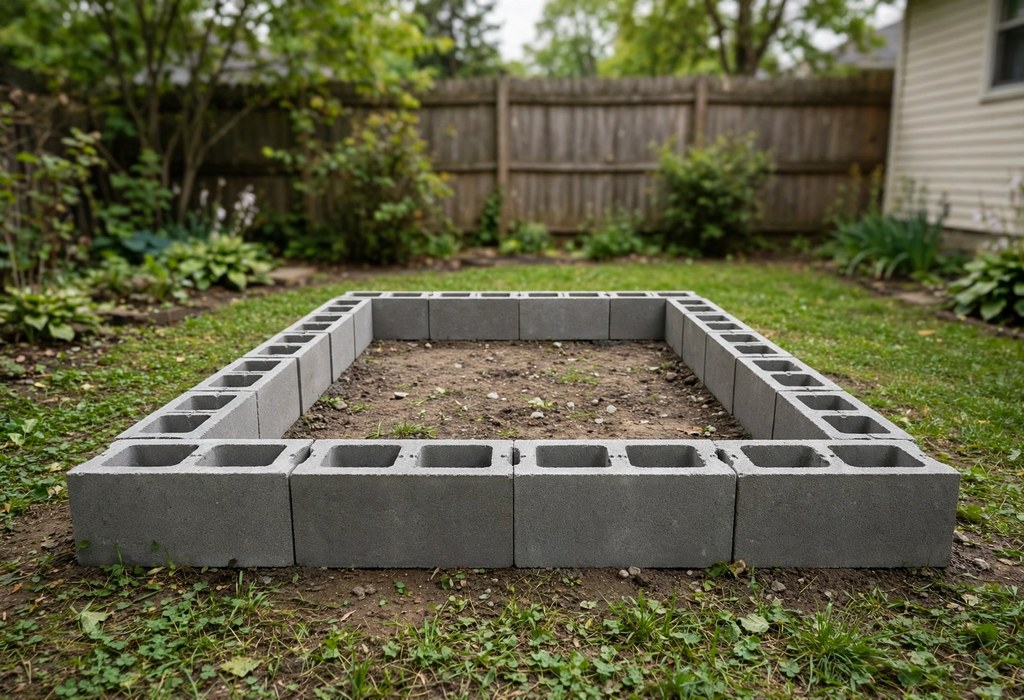
Long sides sit end to end with no gaps between them. Each 8-foot side takes six blocks laid in one straight row. For example, corners in a cinder block raised garden bed start with one shared block. Short ends then fill the space left between the two long walls.
The Corner Overlap Rule
Each corner needs one shared block instead of two separate blocks. The two long sides claim the corner blocks first. Consequently, each short end loses 8 inches of space at both corners. Subtract 16 inches from the 48-inch end before you divide by 16.
Similarly, the remaining 32 inches divide evenly into two blocks per short end. Without this correction, the raw math would double-count four corner blocks. In contrast, a straight perimeter calculation always overcounts rectangular beds. Some gardeners pin corners with rebar, but that choice never changes the count.
Single Course vs Double Courses
One course builds an 8-inch-tall wall with exactly 16 blocks. That height suits shallow-rooted herbs, lettuce, and flowers quite well. However, most vegetables need deeper soil for strong and healthy roots. Two courses create a 16-inch-tall wall and use 32 blocks total.
Additionally, a third course raises the wall to 24 inches and needs 48 blocks. Taller walls cost more but reduce bending during planting and harvest. As a result, choose your wall height before you buy, because courses determine the final total.
Cap Blocks: The Optional Top Layer
Many gardeners finish the wall with flat cap blocks on top. Caps create a smooth edge for sitting and resting tools. Additionally, caps lock the top course in place against shifting. Standard caps measure 16 inches long, so the count matches your wall blocks.
Count one cap block for every wall block in the top course. For example, a two-course 4×8 bed needs 16 cap blocks. Therefore, add caps to your shopping list only if you want the finished edge.
A Reusable Formula for Any Bed Size
Use this simple formula for any rectangular bed you plan. First, convert the full perimeter of the bed to inches. Then divide that number by 16. Finally, subtract two to correct for the shared corners.
Blocks per course equal the perimeter in inches divided by 16, minus 2. Multiply that result by the number of courses in your wall. For example, a 4×4 bed has a 192-inch perimeter and needs 10 blocks per course. A 4×12 bed needs 22 blocks per course by the same math.
Formula at a Glance
- Measure the perimeter: record the length and width of your bed in inches.
- Divide by 16: this step gives the raw block count for one course.
- Subtract 2: this correction removes the double-counted corner blocks.
- Multiply by courses: two courses double the per-course block total.
Worked Example: The 4×8 Bed
Now apply the formula to the classic 4×8 raised bed. Convert 4 and 8 feet to a 288-inch perimeter. Divide 288 by 16 to get 18 blocks. Subtract 2 for the corners, which leaves 16 blocks per course.
Multiply 16 by 2 courses for a total of 32 blocks. Add a 10 percent allowance for waste and breakage. Consequently, 32 blocks plus 4 spares equal 36 blocks to buy. That single number covers the complete materials list for your walls.
Waste and Overage Allowance
Always buy about 10 percent more blocks than your calculation shows. Concrete blocks chip at the corners during transport and handling. Additionally, one cracked block should never stall your building project. Extra blocks also cover future repairs, edging, or small bed extensions.
Rounding up from 32 to 36 blocks costs very little. Meanwhile, leftover blocks work well as planters, edging, or extra garden seats. Use fill block holes to fill the hollow cores. Buy blocks from one batch so the finished color matches.
Frequently Asked Questions
How many cinder blocks do I need for a 4×8 bed with three courses?
You need 48 blocks for three courses, plus about five extra for waste.
Do corner blocks get counted twice in the formula?
No, the formula subtracts two blocks to correct the corner overlap.
What size cinder block works best for raised beds?
Standard 16x8x8-inch blocks work best because they divide evenly into common bed sizes.
Should I use mortar or dry stack for my raised bed?
Dry stacking works well for two courses, while mortar strengthens taller walls.
How much soil does a 4×8 cinder block bed hold?
An 8-inch-deep 4×8 bed holds about 11 cubic feet of soil mix.
Conclusion
You now know exactly how many blocks your 4×8 bed requires. Sixteen blocks per course, two courses, and four spares keep the project simple. Therefore, buy 36 blocks and start laying your first course this weekend.
Finally, share with a friend who plans a new garden bed.